Emerald Ash Borer Treatment
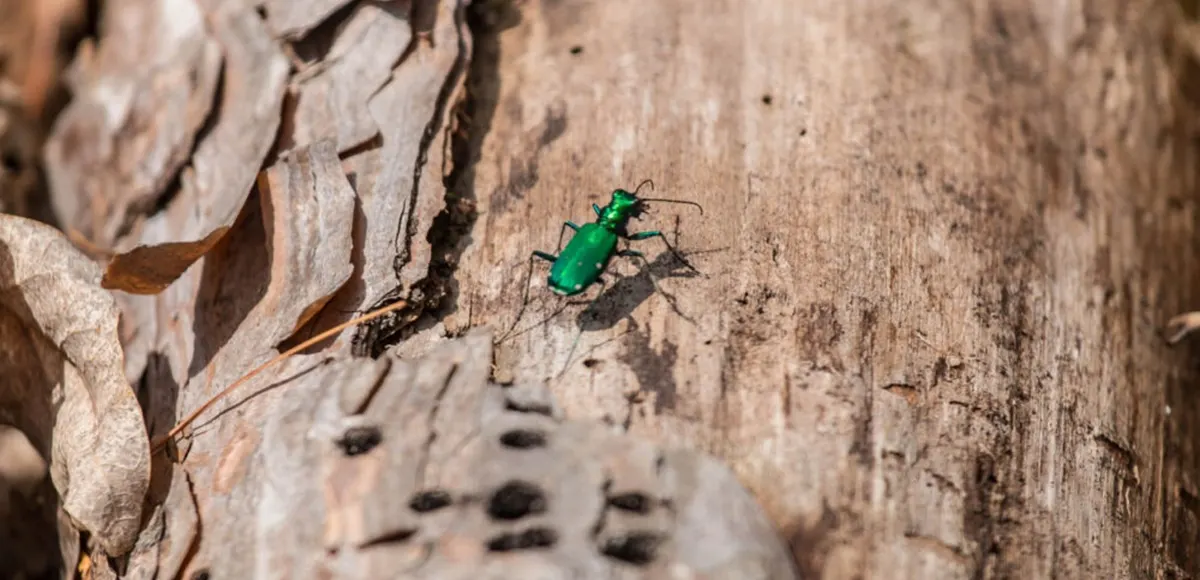
Protect Your Ash Trees with Professional Emerald Ash Borer Treatment
Emerald ash borer treatment is time-sensitive, once damage is advanced, even valuable ash trees can become unsafe and unsalvageable. Valley Tree Services provides professional emerald ash borer treatment to help assess at-risk ash trees, protect those that can still be saved, and plan safe removal and replacement when necessary.
Our certified arborists combine on-site inspections with practical recommendations tailored to each tree. In some cases, that means proactive monitoring and treatment; in others, it means planning for removal and replanting so your property stays safe and attractive over the long term.
To see how emerald ash borer treatment fits into broader tree care, learn more about our tree health and disease management services or request a quote to speak with our team.
What Is Emerald Ash Borer and Why Treatment Matters?
Emerald ash borer (EAB) is an invasive beetle that targets ash trees. The adult beetles feed on foliage, but the most serious damage happens when larvae tunnel under the bark and disrupt the tree’s ability to move water and nutrients. Over several years, this internal damage can cause canopy dieback, structural weakness, and, ultimately, tree death.
Key reasons to act early include:
- Hidden damage: By the time you notice canopy thinning or bark splitting, larvae may have already caused significant internal damage. Early detection and treatment give you the best chance of preserving a tree.
- Safety concerns: Declining ash trees can shed large branches or fail at the trunk, especially during storms. Managing EAB isn’t just about tree health, it’s also about protecting people, buildings, and vehicles.
- Long-term planning: Not every ash tree is a good candidate for treatment. Some are better managed through phased removal and replacement planting. A professional assessment helps you invest in the right trees.
For general background on emerald ash borer biology and spread, government resources like national fact sheets are useful references.
Our Trusted Partners


Signs Your Ash Tree May Need Emerald Ash Borer Treatment
Early recognition is critical. According to the City of Ottawa’s official page on EAB signs and symptoms, infested ash trees may display yellowing leaves, canopy thinning, and unusual branch growth near the base. The city also reports that woodpecker activity is often one of the first visible clues, as they feed on EAB larvae beneath the bark.
If you have ash trees on your property, our arborists recommend watching for:
- Thinning or dying branches in the upper canopy
- D-shaped exit holes in the bark made by emerging adult beetles
- Bark cracks or splitting, sometimes revealing S-shaped larval galleries underneath
- Epicormic shoots (new shoots) sprouting from the trunk or base of the tree
- Woodpecker activity focused on ash trunks and branches
These signs don’t automatically mean your tree can be treated, but they do mean it’s time for a professional tree assessment so we can evaluate your options.
Is Your Ash Tree a Candidate for Emerald Ash Borer Treatment?
Not every ash tree should be treated. Our goal is to help you identify which trees are worth investing in and which are better managed through removal and replacement. During an on-site visit, our arborists consider:
- Extent of canopy decline: Trees with limited crown dieback may still respond to treatment, while those with severe dieback are often beyond recovery.
- Structural condition and safety: If a tree is already structurally compromised, treatment may not address the underlying safety risk, and tree removal services may be the safest option.
- Location and value of the tree: High-visibility or strategically placed trees—such as those providing shade or privacy, are often strong candidates for treatment if their condition allows.
- Budget and long-term plan: Some ash trees can be maintained with ongoing monitoring and treatment, while others may be scheduled for removal and replacement through our tree planting services.
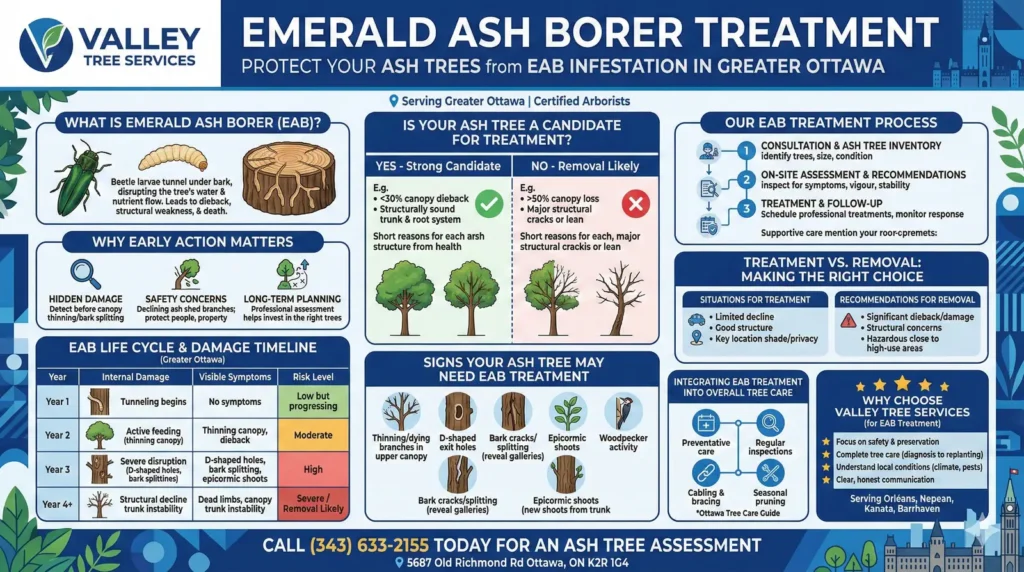
Emerald Ash Borer Life Cycle & Damage Timeline in Greater Ottawa
Understanding how Emerald Ash Borer (EAB) progresses helps property owners in Greater Ottawa act before structural damage becomes severe. The table below outlines the typical infestation stages and what they mean for ash tree survival.
EAB Stage | What’s Happening Inside the Tree | Visible Symptoms | Risk Level |
Year 1 – Early Infestation | Larvae begin tunneling beneath bark, disrupting nutrient transport | Often no visible symptoms | Low but progressing |
Year 2 – Active Feeding | Increased larval galleries damage vascular system | Thinning canopy, small branch dieback | Moderate |
Year 3 – Advanced Damage | Severe internal disruption of water and nutrient flow | D-shaped exit holes, bark splitting, epicormic shoots | High |
Year 4+ – Structural Decline | Extensive internal decay and structural weakening | Large dead limbs, significant canopy loss, trunk instability | Severe / Removal Likely |
This timeline highlights why early Emerald Ash Borer treatment in Greater Ottawa is critical before trees become hazardous.
Signs Your Ash Tree May Be a Good Candidate for Treatment
Not every ash tree should be removed. In many Ottawa neighborhoods, healthy trees with early-stage infestation can still respond well to treatment. The chart below outlines treatment candidacy factors.
Tree Condition | Treatment Recommended? | Why It Matters |
Less than 30% canopy dieback | Yes – Strong Candidate | Tree can still transport nutrients effectively |
Structurally sound trunk & root system | Yes – Good Candidate | Stability supports long-term survival |
Moderate canopy thinning (30–50%) | Case-by-case | Requires detailed arborist evaluation |
Severe canopy loss (50%+) | Usually No | Advanced decline reduces treatment success |
Major structural cracks or lean | No – Removal Likely | Safety risk outweighs preservation benefits |
This approach ensures investments are focused on ash trees with the highest likelihood of recovery.
Our Emerald Ash Borer Treatment Process
Every property is different, but our emerald ash borer treatment process follows a consistent, transparent approach so you know what to expect from first contact to follow-up.
Step 1 – Consultation and Ash Tree Inventory
We begin by identifying all ash trees on your property, noting their size, location, and visible condition. You can share photos and basic information using our online request a quote form, and we’ll schedule a site visit as needed.
Step 2 – On-Site Assessment and Recommendations
During the visit, our arborists inspect each ash tree, looking for EAB symptoms, overall vigour, and structural stability. Based on what we find, we outline options that may include:
- Ongoing monitoring and preventative care
- Professional emerald ash borer treatment for suitable trees
- Phased removal for high-risk or severely affected ash
- Replacement planting to maintain canopy cover over time
When appropriate, we may suggest incorporating your EAB plan into a broader tree health and disease management program.
Step 3 – Treatment and Follow-Up
For trees selected for treatment, our team will:
- Schedule treatments at appropriate times in the growing season
- Apply products using professional methods suited to the tree’s size and location
- Monitor response over time and adjust recommendations as needed
Alongside treatment, we often recommend supportive care such as proper watering, mulching, and pruning by our tree pruning and trimming team to reduce other stresses on the tree.
Treatment vs. Removal: Making the Right Choice
Choosing between emerald ash borer treatment and removal can be difficult. Our role is to help you weigh the options based on safety, cost over time, and your goals for the property.
Situations where treatment may be appropriate:
- The ash tree shows limited canopy decline
- The tree has good overall structure and no major decay
- The tree is in a key location for shade, privacy, or curb appeal
- You’re prepared to invest in monitoring and periodic treatments
Situations where removal may be recommended:
- Significant canopy dieback or advanced EAB damage
- Structural concerns (large dead branches, lean, trunk defects)
- The tree is close to high-use areas where failure would be hazardous
- You prefer to move toward a different, more resilient species mix
When removal is necessary, we can handle the entire process, from tree removal services and stump grinding to follow-up planting, so you’re not left coordinating multiple contractors.
Integrating EAB Treatment into Overall Tree Care
Emerald ash borer treatment is just one part of a comprehensive tree care strategy. We often combine EAB management with:
- Preventative tree care to reduce stress and improve resilience
- Regular inspections to monitor for other pests and diseases
- Cabling and bracing for structurally vulnerable trees
- Seasonal pruning and maintenance to improve structure and airflow
By planning ahead, you can reduce the likelihood of surprise emergencies and avoid having to remove multiple mature trees at once. To build a proactive plan, many property owners pair EAB work with our commercial and municipal tree services and refer to our Ottawa tree care guide for local best practices.
For more general education on emerald ash borer in Canada, municipal and federal sites provide useful overviews of local programs and guidelines.
Why Choose Valley Tree Services
When dealing with emerald ash borer, you need advice you can trust and a plan that looks beyond a single season. Property owners choose Valley Tree Services for EAB treatment because we:
- Focus on both safety and preservation: We’ll help you protect ash trees that are good candidates for treatment and recommend removal when a tree can’t be safely or effectively saved.
- Offer complete tree care: From diagnosis and emerald ash borer treatment to removal, stump grinding, and replanting, we manage the entire life cycle of your trees.
- Understand local conditions: Our arborists are familiar with local tree species, climate, and regional pest pressures, so recommendations reflect real-world conditions rather than generic advice.
- Provide clear, honest communication: We explain what we see, why it matters, and your options, so you can make informed decisions that align with your priorities and budget.
To see how we work and what other clients have experienced, visit our About page, meet our arborists, and read client testimonials. We are also proud to be guided by industry best practices, such as those outlined by the International Society of Arboriculture , ensuring our treatments meet the highest professional standards.
Areas We Serve in Ottawa
With a mix of urban and natural environments, Orléans requires tailored tree maintenance. We offer inspections, pruning, and pest control to protect residential landscapes.
Nepean’s mature neighborhoods and green spaces benefit from professional tree care. We provide expert pruning, safe removals, and disease control to preserve the local tree canopy.
Kanata is home to both new developments and established treescapes. Our team supports residents with planting, trimming, and emergency tree services for year-round safety.
In this rapidly growing suburb, we help homeowners manage storm damage, remove hazardous trees, and keep their properties safe and visually appealing.
What Our Clients Are Saying
We believe the best proof of our service comes directly from the homeowners, businesses, and property managers we proudly serve.
Excellent work, and great cleanup at the end. The guys are friendly and know their work exceptionally well. Any tree issues, and they are there quickly to solve the problem. No hesitation in calling them in the future.

Have had them come do some work on our tree a few times now over the years and always a great job, very professional and good pricing.
Valley Tree Services did an excellent job with our tree removal, and on a very hot summer day and did an excellent job with our tree trimming and stump/root removal. So grateful and would recommend them!
Awesome service with these guys. They removed several trees from our property and they left virtually no trace that work had even been done. They also cut up some larger trees that had already fallen. They were very professional. I highly recommend this business.
Great service. Valley Tree Services were very attentive to our specific concerns and came up with a plan to extend the life of our damaged tree. We have used them three times and have been very happy with their services and expertise.
Frequently Asked Questions
Emerald ash borer treatment refers to targeted care for ash trees at risk from or already affected by emerald ash borer. In many cases, this involves professional insecticide applications and ongoing monitoring, combined with supportive care such as proper watering, mulching, and pruning. The goal is to protect suitable trees before damage becomes too advanced.
Whether an ash tree can be saved depends on how far the infestation has progressed and the tree’s overall health and structure. Trees with limited canopy dieback and sound structure may respond to treatment and supportive care, while those with extensive decline or significant structural issues are often better managed through removal and replacement. A professional tree assessment is the best way to know your options.
Treatment frequency depends on the product used, local pest pressure, and the condition of the tree. Many treatment programs follow a recurring schedule over multiple years, paired with regular inspections to confirm how the tree is responding. Our arborists will explain what schedule makes sense for your ash trees and review it with you before any work begins.
There’s no one-size-fits-all answer. Treatment may be appropriate for healthy, structurally sound ash trees in key locations, while removal is often recommended for trees with advanced decline, major structural concerns, or limited long-term value. We’ll help you weigh safety, cost over time, and your landscape goals when deciding between emerald ash borer treatment and tree removal services.
Homeowner products exist, but effective emerald ash borer treatment typically requires correct diagnosis, proper timing, and professional application methods, especially for larger ash trees. Incorrect use of products can be ineffective and may pose risks to people, pets, and the environment. We recommend working with qualified arborists who understand local regulations and best practices.
If emerald ash borer is present and no action is taken, most infested ash trees will continue to decline and eventually die. As they weaken, the risk of branch failure or complete tree failure increases, especially in storms. This can pose hazards to nearby structures, vehicles, and people. We can help you decide whether treatment, removal, or a combination of both is the most responsible approach for your property.
Get a Free Estimate
Our Tree Services
Why Choose Valley Tree Services
When dealing with emerald ash borer, you need advice you can trust and a plan that looks beyond a single season. Property owners choose Valley Tree Services for EAB treatment because we:
- Focus on both safety and preservation: We’ll help you protect ash trees that are good candidates for treatment and recommend removal when a tree can’t be safely or effectively saved.
- Offer complete tree care: From diagnosis and emerald ash borer treatment to removal, stump grinding, and replanting, we manage the entire life cycle of your trees.
- Understand local conditions: Our arborists are familiar with local tree species, climate, and regional pest pressures, so recommendations reflect real-world conditions rather than generic advice.
- Provide clear, honest communication: We explain what we see, why it matters, and your options, so you can make informed decisions that align with your priorities and budget.
To see how we work and what other clients have experienced, visit our About page, meet our arborists, and read client testimonials. We are also proud to be guided by industry best practices, such as those outlined by the International Society of Arboriculture , ensuring our treatments meet the highest professional standards.
Valley Tree Services
Business Hours
Monday: 7AM – 6PM
Tuesday: 7AM – 6PM
Wednesday: 7AM – 6PM
Thursday: 7AM – 6PM
Friday: 7AM – 6PM
Saturday: 9AM – 5PM
Sunday: 9AM – 5PM

Get Started
Our friendly staff is happy to guide you through our wide range of tree services in Ottawa and match you with the right service for your property’s unique needs. We work with residential homeowners, property managers, commercial sites, and municipal clients.
Get a Free Estimate