Tree Health & Disease Management Services
Keep Your Trees Healthy, Safe, and Strong
Healthy trees add shade, privacy, and value to your property, but disease, pests, and soil problems can quietly weaken them over time. Valley Tree Services provides professional tree health and disease management services designed to catch issues early, protect valuable trees, and reduce the risk of unexpected failure.
Our certified arborists assess tree health from the canopy to the root zone, then build a tailored care plan that may include pruning, disease or pest management, soil improvements, and ongoing monitoring. Whether you’re worried about one high-value tree or an entire landscape, we help you understand what’s happening and what to do next.
You can explore our full range of tree services or speak directly with our team using the request a quote form.
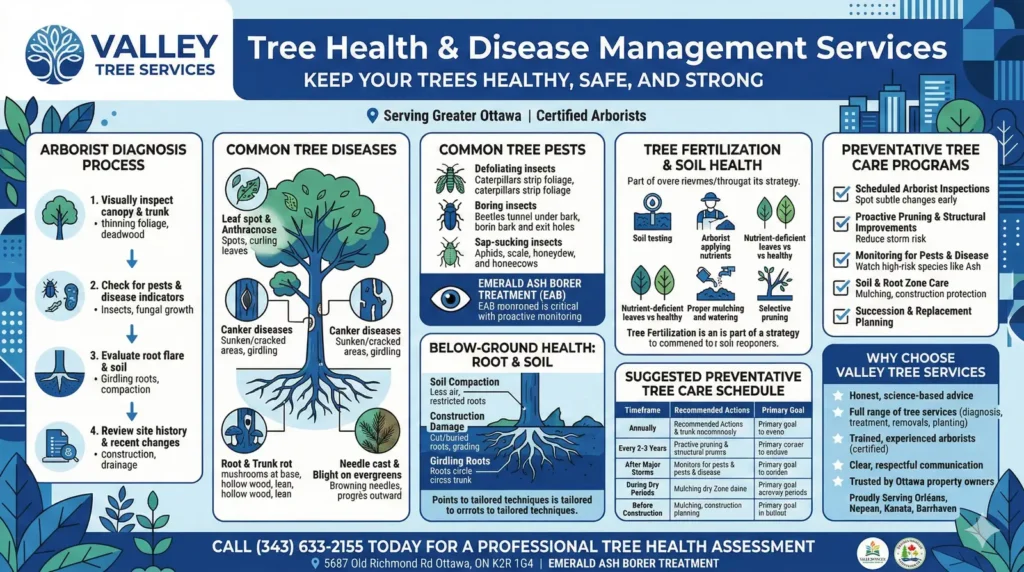
How Our Arborists Diagnose Tree Health Problems
Before recommending any treatment, we start with a thorough tree health assessment. Our goal is to identify what’s stressing your tree, disease, insects, soil issues, weather damage, or a combination, so we can recommend the right solution.
During a typical tree health inspection, our arborists may:
- Visually inspect the canopy and trunk: We look for symptoms like thinning foliage, discoloured leaves, cankers, cracks, and deadwood, early warning signs that something is wrong.
- Check for pests and disease indicators: We examine leaves, bark, and branches for insects, exit holes, fungal growth, or unusual patterns that point to specific pests or diseases.
- Evaluate the root flare and surrounding soil: Surface roots, girdling roots, standing water, and compacted soil can all contribute to decline. We look closely at the base of the trunk and root zone.
- Review site history and recent changes: Construction, grading, new driveways, or changes in drainage can all affect tree health. We factor in what has changed on your property in the last few years.
When needed, we may recommend more detailed tree assessments to evaluate structural stability or risk, especially for trees near homes, driveways, or play areas.
Our Trusted Partners




Tree Diseases in Ottawa
Trees in and around Ottawa are exposed to a range of fungal, bacterial, and environmental diseases. Some diseases primarily affect leaves and appearance, while others weaken the structure or attack the vascular system, making the tree unsafe over time.
Common concerns our arborists see include:
- Leaf spot and anthracnose diseases: These often show up as brown or black spots, blotches, or curling leaves. While some cosmetic leaf diseases are manageable, repeated infections can stress trees and reduce vigour.
- Canker diseases: Cankers appear as sunken, cracked, or discoloured areas on branches or trunks. Over time, they can girdle branches, lead to dieback, or create weak points where branches may break.
- Root and trunk rot: Fungi that attack the root system or lower trunk can be hard to spot early. Mushrooms near the base, soft or hollow wood, and significant lean may all indicate serious decay.
- Needle cast and blight on evergreens: Evergreen diseases often cause browning or premature needle drop, starting on the inside of the tree and progressing outward. Early diagnosis can sometimes slow or manage the problem.
Our tree health and disease management services focus on early detection and practical recommendations. In some cases, targeted pruning or cultural changes (watering, mulching, soil aeration) can help trees recover. In advanced cases, we may recommend tree removal to protect people and property.
For additional background on common tree diseases, you can also consult Canadian tree disease resources.
Tree Pests in Canada
Across Canada, trees face pressure from both native and invasive insects. Some pests cause cosmetic damage, while others like emerald ash borer can be deadly if not addressed.
Examples of pest issues our arborists routinely look for include:
- Defoliating insects: Caterpillars and other leaf-eating insects can quickly strip foliage, stressing trees and making them more vulnerable to other problems.
- Boring insects: Beetles and borers tunnel under bark or into wood, disrupting the tree’s ability to move water and nutrients. Small exit holes, sawdust-like frass, or peeling bark can indicate their presence.
- Sap-sucking insects: Aphids, scale, and similar insects feed on sap and may cause sticky honeydew, leaf curling, or overall decline in vigour.
- Invasive pests like emerald ash borer (EAB): EAB has killed millions of ash trees across North America. If you have ash trees, proactive monitoring and management are critical. You can learn more about local ash protection and removal options on our emerald ash borer page.
Our pest management approach is focused on integrated strategies, inspection, correct identification, and then recommending the least-disruptive, most effective options available for your situation. When pest damage is too advanced, we may discuss staged removal and replacement through our tree planting services.
For broader context on invasive forest insects, federal agencies provide helpful forest pest alerts.
Common Tree Disease Symptoms and What They May Mean
This overview table links visible symptoms to possible disease issues and why they matter. It’s not a diagnosis tool, but it can help you decide when to call an arborist for a closer look.
Visible Symptom | Possible Issue Type | Why It Matters for Tree Health |
Spots or blotches on leaves | Leaf spot, anthracnose | Repeated infections can weaken trees and reduce growth over time |
Sections of dead branches in canopy | Canker disease, dieback | Deadwood can fall and may signal deeper structural problems |
Mushrooms near trunk base | Root or butt rot | Indicates internal decay that can affect stability |
Premature leaf or needle drop | Foliar disease, stress | Trees may be stressed and more susceptible to other problems |
Cracks or sunken areas on trunk | Cankers, past injury | Structural weakness and potential entry for pests and decay |
Root Damage & Soil Compaction
Many tree problems start below ground, where roots and soil conditions quietly determine how well a tree can access water, air, and nutrients. In urban and suburban settings, root damage and soil compaction are some of the most common, and overlooked, causes of decline.
Our arborists look for:
- Compacted soil from foot traffic or vehicles: Repeated pressure over root zones compresses soil particles, reducing air gaps and limiting root growth. Trees may show thinning crowns, smaller leaves, or increased stress during heat and drought.
- Construction and grading damage: Excavation, trenching, and changes to grade can cut or bury major roots. Even if a tree looks fine immediately after construction, damage can show up years later as dieback or instability.
- Girdling and surface roots: Roots circling at or near the trunk can constrict the tree over time. Surface roots can also be damaged repeatedly by mowing or equipment.
Where appropriate, our tree health plans may include:
- Loosening compacted soil through targeted techniques
- Adjusting mulch and watering practices to support root recovery
- Recommending tree cabling and bracing or pruning when structure has been compromised
- Advising when a tree has become unsafe and should be removed, often coordinated with emergency tree services if there is immediate risk
By addressing root and soil issues early, we can often improve tree health and reduce the likelihood of emergency situations.
Tree Fertilization & Soil Health
Fertilization is most effective when it’s part of a broader soil health strategy—not just a quick fix. Our arborists take into account the tree species, age, site conditions, and visible symptoms before recommending fertilization as part of tree health and disease management.
Key considerations include:
- Soil nutrient levels and structure: Trees growing in thin, disturbed, or construction-fill soils may benefit from targeted nutrient support and organic matter improvements.
- Signs of nutrient deficiency: Pale foliage, poor growth, or early fall colour can be linked to nutrient imbalances, but may also connect to root or moisture issues, which we assess first.
- Species-appropriate care: Different species have different nutrient needs and tolerances. What’s helpful for one tree can be excessive for another.
In many cases, our recommendations combine fertilization with:
- Proper mulching around the root zone
- Adjustments to watering practices
- Selective tree pruning to reduce stress
- Ongoing monitoring as part of a preventative care plan
We’ll clearly explain whether fertilization is recommended for your trees, and if so, how it fits into an overall health management strategy rather than being used in isolation.
Preventative Tree Care Programs
The most effective way to manage tree health and disease is to prevent problems—or catch them early, rather than reacting after significant damage occurs. Valley Tree Services can design preventative tree care programs tailored to your property and goals.
A preventative plan may include:
- Scheduled inspections by an arborist: Regular check-ups allow us to spot subtle changes in leaf colour, growth, or structure and respond before problems escalate.
- Proactive pruning and structural improvements: Corrective pruning reduces weak or crossing branches, improves airflow, and lowers the risk of breakage during storms.
- Monitoring for pests and disease: High-risk species or known local issues (such as emerald ash borer) are watched closely so treatment or removal decisions can be made at the right time.
- Soil and root zone care: Mulching, soil management, and root protection during construction help trees handle stress better.
- Planning for succession and replacement: Older or high-risk trees can be phased out over time with new plantings through our tree planting services, so your landscape remains safe and attractive.
If you’d like to learn more about seasonal tasks and local best practices, our Ottawa tree care guide and seasonal tree care tips are great resources you can reference throughout the year.
Suggested Preventative Tree Care Schedule
While every property is unique, the table below outlines a general schedule of preventative care tasks that help keep trees healthier and reduce the risk of unexpected problems.
Timeframe / Frequency | Recommended Actions | Primary Goal |
Annually | Arborist inspection, light structural pruning | Catch issues early, maintain safe structure |
Every 2–3 years | More detailed health assessment and canopy review | Monitor disease, pests, and long-term stability |
After major storms | Visual check for damage or leaning | Address safety concerns before they worsen |
During dry periods | Adjusted watering and mulch checks | Reduce drought stress and support root health |
Before construction work | Pre-construction tree protection planning | Minimize root and soil damage from site changes |
Emerald Ash Borer Treatment
Emerald Ash Borer (EAB) has devastated ash tree populations across Greater Ottawa, making early detection and proactive treatment critical. This invasive beetle disrupts a tree’s ability to transport water and nutrients, often leading to canopy thinning and branch dieback within just a few years. Our arborists inspect ash trees for signs of infestation and provide tailored Emerald Ash Borer treatment plans, monitoring, or staged removal when necessary to protect surrounding landscapes and preserve healthy trees whenever possible.
Why Choose Valley Tree Services
When you’re concerned about tree health, you want more than a quick “yes or no” answer, you want clear explanations and practical options. Homeowners, property managers, and organizations choose Valley Tree Services because we:
- Provide honest, science-based advice: Our recommendations are focused on long-term tree health and site safety, not just short-term fixes.
- Offer a full range of tree services: From diagnosis and treatment to pruning, cabling, removals, stump grinding, and new planting, we can manage the complete life cycle of your trees.
- Employ trained, experienced arborists: Our team understands local species, climate stresses, and regional pests and diseases, so you get guidance that fits real-world conditions.
- Communicate clearly and respectfully: We take time to explain what we see, why it matters, and what your options are, so you can make informed decisions that align with your priorities and budget.
- Trusted by Ottawa Property Owners: We’ve built a reputation for honest quotes, prompt service, and exceptional outcomes. See why locals recommend us on our testimonials page and Google Business Profile.
Areas We Serve in Ottawa
With a mix of urban and natural environments, Orléans requires tailored tree maintenance. We offer inspections, pruning, and pest control to protect residential landscapes.
Nepean’s mature neighborhoods and green spaces benefit from professional tree care. We provide expert pruning, safe removals, and disease control to preserve the local tree canopy.
Kanata is home to both new developments and established treescapes. Our team supports residents with planting, trimming, and emergency tree services for year-round safety.
In this rapidly growing suburb, we help homeowners manage storm damage, remove hazardous trees, and keep their properties safe and visually appealing.
What Our Clients Are Saying
We believe the best proof of our service comes directly from the homeowners, businesses, and property managers we proudly serve.
Excellent work, and great cleanup at the end. The guys are friendly and know their work exceptionally well. Any tree issues, and they are there quickly to solve the problem. No hesitation in calling them in the future.

Have had them come do some work on our tree a few times now over the years and always a great job, very professional and good pricing.
Valley Tree Services did an excellent job with our tree removal, and on a very hot summer day and did an excellent job with our tree trimming and stump/root removal. So grateful and would recommend them!
Awesome service with these guys. They removed several trees from our property and they left virtually no trace that work had even been done. They also cut up some larger trees that had already fallen. They were very professional. I highly recommend this business.
Great service. Valley Tree Services were very attentive to our specific concerns and came up with a plan to extend the life of our damaged tree. We have used them three times and have been very happy with their services and expertise.
Frequently Asked Questions
Early signs of tree disease can include thinning foliage, discoloured or spotted leaves, premature leaf drop, dead or dying branches in the crown, oozing or sunken areas on the trunk, and visible fungal growth near the base. If you notice more than one of these symptoms, it’s a good idea to schedule a professional tree assessment to determine what’s happening.
Many pests and diseases create similar symptoms, which is why correct identification is important. Our arborists look for specific clues, such as insect presence, exit holes, frass, leaf patterns, or fungal structures, and consider site history and weather conditions to pinpoint the cause. In some cases, stress from soil compaction or drought may be the underlying issue, with pests or disease taking advantage of a weakened tree.
Not all sick trees need to be removed. If problems are caught early and the structure is still sound, pruning, pest or disease management, and improved soil care may help a tree recover or stabilize. When a tree is severely decayed, structurally unsound, or poses a risk to people and property, we may recommend tree removal and, where appropriate, replacement planting.
Most established trees benefit from a professional inspection every 1–3 years, depending on their age, species, and location. Trees near buildings, driveways, and play areas, or those exposed to construction or storm damage, may need more frequent monitoring. Our preventative care programs can be customized so inspections happen at appropriate intervals.
We can inspect ash trees for signs of emerald ash borer and discuss available management options, which may include monitoring, selective treatment, or staged removal and replacement. For detailed information on this particular pest, visit our emerald ash borer page. Similar assessment and recommendation processes apply for other pest issues as well.
Simple steps like proper watering, mulching (without piling mulch against the trunk), avoiding damage from lawn equipment, and watching for changes in foliage or structure go a long way. Our Ottawa tree care guide and seasonal tree care tips provide practical checklists you can follow throughout the year.
Get a Free Estimate
Our Tree Services
Why Choose Valley Tree Services
When you’re concerned about tree health, you want more than a quick “yes or no” answer, you want clear explanations and practical options. Homeowners, property managers, and organizations choose Valley Tree Services because we:
- Provide honest, science-based advice: Our recommendations are focused on long-term tree health and site safety, not just short-term fixes.
- Offer a full range of tree services: From diagnosis and treatment to pruning, cabling, removals, stump grinding, and new planting, we can manage the complete life cycle of your trees.
- Employ trained, experienced arborists: Our team understands local species, climate stresses, and regional pests and diseases, so you get guidance that fits real-world conditions.
- Communicate clearly and respectfully: We take time to explain what we see, why it matters, and what your options are, so you can make informed decisions that align with your priorities and budget.
- Trusted by Ottawa Property Owners: We’ve built a reputation for honest quotes, prompt service, and exceptional outcomes. See why locals recommend us on our testimonials page and Google Business Profile.
Valley Tree Services
Business Hours
Monday: 7AM – 6PM
Tuesday: 7AM – 6PM
Wednesday: 7AM – 6PM
Thursday: 7AM – 6PM
Friday: 7AM – 6PM
Saturday: 9AM – 5PM
Sunday: 9AM – 5PM

Get Started
Our friendly staff is happy to guide you through our wide range of tree services in Ottawa and match you with the right service for your property’s unique needs. We work with residential homeowners, property managers, commercial sites, and municipal clients.
Get a Free Estimate