Tree Cabling & Bracing Services
Professional Tree Cabling & Bracing Services for Vulnerable Trees
When a mature or high-value tree develops structural weaknesses, full removal isn’t always the only option. Our professional tree cabling & bracing services are designed to provide extra support to compromised trees, helping reduce the risk of failure and extend their safe lifespan on your property.
Valley Tree Services can install modern, industry-standard tree support systems that help:
- Stabilize large, heavy limbs
- Support weak branch unions
- Protect nearby structures, vehicles, and walkways
- Preserve the shade, beauty, and privacy your trees provide
To see how this service fits into your overall tree care plan, explore our full range of tree services.
What Is Tree Cabling and Bracing?
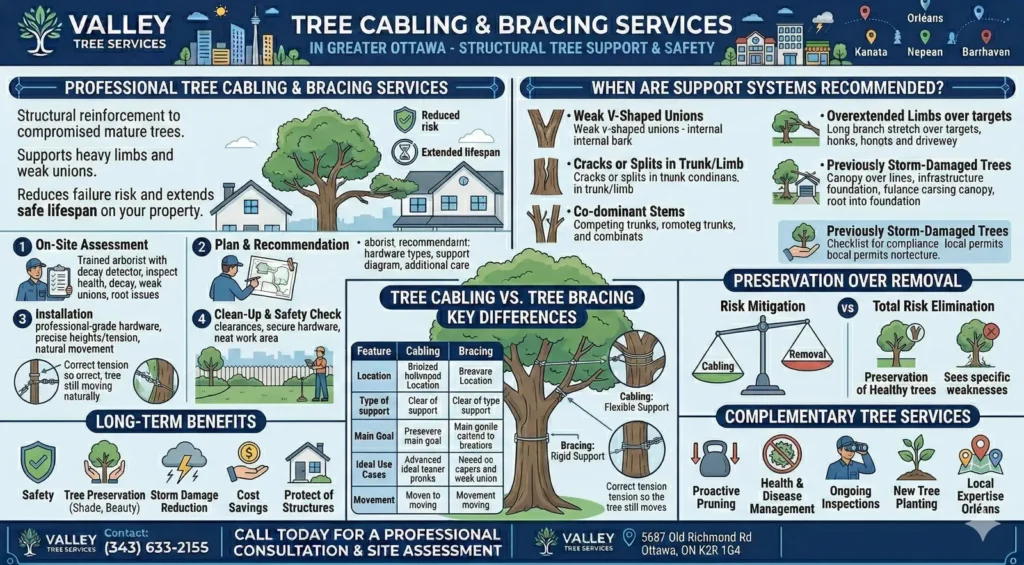
Tree cabling and bracing are structural support techniques used by arborists to reinforce weakened or at-risk parts of a tree. According to the International Society of Arboriculture (ISA), these systems are supplemental and intended to reduce the risk of failure, though they do not eliminate it entirely. While they’re often mentioned together, they serve different purposes and are used in different parts of the tree.
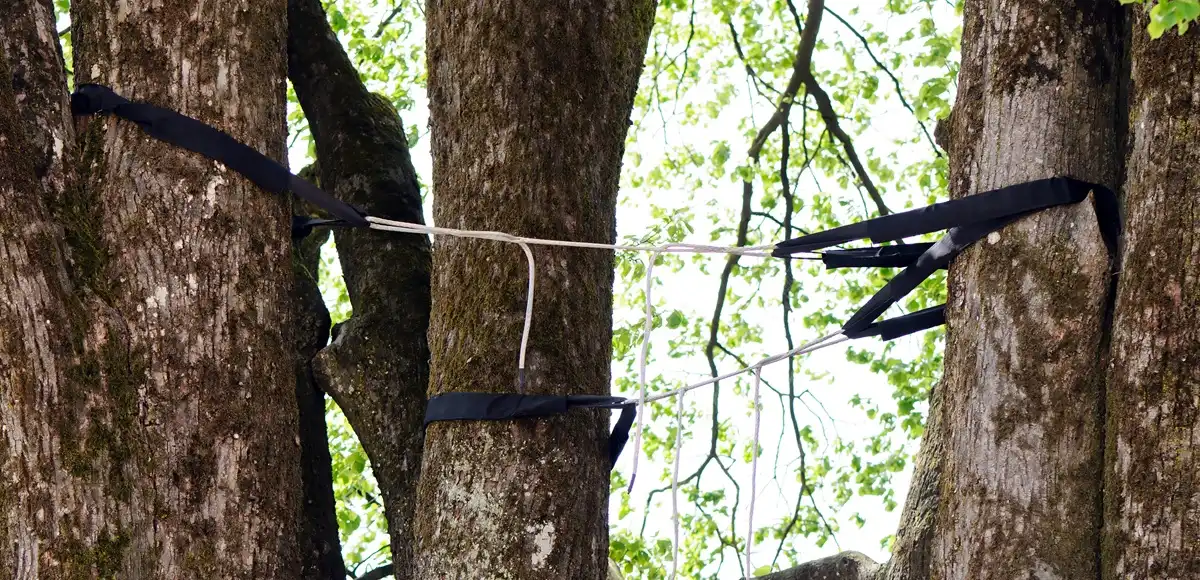
Tree cabling typically involves installing high-strength cables between major limbs or from a limb to the main trunk, higher in the canopy. These flexible supports help:
- Share weight between branches
- Reduce movement and stress during wind and storms
- Lower the chance of limb splitting or breaking
Tree bracing uses rigid support rods or braces, usually installed lower in the canopy or within the trunk where there is a visible crack or weak union. Bracing helps:
- Reinforce cracked or split sections
- Add internal strength to weak branch attachments
- Support trees with co-dominant stems or included bark
Together, tree cabling and bracing create a support system that helps your tree better withstand wind, snow load, and everyday stresses while reducing the risk of sudden failure.
Our Trusted Partners




When Do Trees Need Cabling or Bracing?
Not every leaning or oddly shaped tree needs structural support. That’s why an on-site assessment by a trained arborist is essential before recommending tree cabling & bracing services.
Common situations where cabling or bracing may be recommended include:
- Weak or “V-shaped” branch unions with included bark
- Cracks or splits in the trunk or major limbs
- Co-dominant stems competing to be the main leader
- Overextended limbs stretching over driveways, roofs, play areas, or power lines
- Mature trees with heavy canopies in high-wind or high-snow-load areas
- Previously storm-damaged trees that you want to preserve if possible
If you’ve noticed any of these issues, or if a large tree close to your home is making you nervous during storms, Valley Tree Services can inspect the tree and advise whether cabling, bracing, pruning, or removal is the safest option. You can schedule a detailed tree assessment and inspection to get professional guidance.
Our Tree Cabling & Bracing Process
Every property and tree is unique, so we follow a clear, safety-focused process before installing any support systems:
1. On-Site Assessment
Our team inspects the tree’s overall health, structure, and surrounding conditions. We look for cracks, decay, weak unions, root issues, past storm damage, and potential targets (homes, vehicles, play areas, power lines).
2. Recommendation & Plan
If tree cabling and bracing are appropriate, we explain:
- Where supports will be installed
- What type of hardware will be used
- How the system will help manage risk
- Any additional pruning or follow-up care recommended
In many cases, we may also recommend targeted tree pruning and trimming to reduce weight on overextended limbs and improve the tree’s overall structure. We’ll also outline situations where support alone is not enough and tree removal may be the safer choice.
3. Installation of Tree Support Systems
Using professional-grade hardware and proper techniques, we:
- Drill and install hardware only where necessary
- Place cables at recommended heights and locations in the canopy
- Use appropriate tension so the tree can still move naturally in the wind
- Install bracing rods where needed to reinforce cracks or weak unions
4. Clean-Up & Safety Check
Once installation is complete, we check clearances, verify all hardware is secure, and clean up our work area so your yard is left neat and safe.
5. Follow-Up Monitoring
Tree cabling and bracing systems should be inspected periodically. During future visits for pruning, assessments, or general tree care, we can monitor the support systems and advise on any adjustments or replacements that may be needed over time.
Benefits of Tree Cabling and Bracing
Investing in tree cabling and bracing can provide several long-term benefits for your property and your trees:
- Improved safety – Reduce the risk of large limbs or stems failing over homes, driveways, vehicles, or public areas.
- Tree preservation – Support valued trees that provide shade, privacy, and curb appeal so you can keep them longer.
- Storm damage reduction – Help trees better withstand high winds, ice, and heavy snow loads.
- Cost savings over time – In some cases, cabling and bracing can be more cost-effective than repeated storm clean-ups or the loss of a mature tree.
- Protection of nearby structures – Stabilizing high-risk limbs can help protect roofs, fences, sheds, and other landscape features.
For trees that are too compromised or unsafe even with support, we can discuss removal and replacement options. And if a storm does cause damage, our emergency tree services team can respond quickly to make the area safe.
Tree Cabling & Bracing vs. Tree Removal
Tree cabling and bracing focus on risk reduction, not risk elimination. In some situations, support systems can meaningfully lower the chance of failure and allow you to keep a tree you value. In other cases, tree removal remains the safest option.
Cabling and bracing may be suitable when:
- The tree is generally healthy and structurally sound aside from specific weaknesses
- The target area (what the tree could fall on) can’t easily be moved or avoided
- You want to preserve a mature, established tree as long as it remains reasonably safe
Tree removal may be recommended when:
- There is extensive decay, disease, or root damage
- The tree has a severe lean with poor root anchorage
- A failure would likely result in serious property damage or injury
- The cost of ongoing monitoring and support outweighs the benefits
If removal is needed, Valley Tree Services can safely take down the tree and help you plan for stump grinding or replacement planting. We offer professional tree removal services and complete stump grinding to leave your property clean and ready for future planting.
For more on how structural support fits into a broader urban forestry context, resources like Tree Canada’s guide on tree maintenance provide excellent background.
Tree Cabling vs. Tree Bracing: Key Differences
Understanding the practical differences between tree cabling and bracing helps you see why an arborist might recommend one or both techniques for your tree. The table below compares how each method is used, what it supports, and the type of problems it addresses.
Feature / Purpose | Tree Cabling | Tree Bracing |
Typical location in the tree | Higher in the canopy between major limbs or to the main stem | Lower in the canopy or within the trunk |
Type of support | Flexible support using high-strength cables | Rigid internal support using rods or braces |
Main goal | Share weight, reduce movement, and limit limb stress | Reinforce cracks and weak unions, increase structural strength |
Ideal use cases | Overextended limbs, heavy canopies, limbs over targets | Cracked stems, split crotches, co-dominant stems with weak unions |
Effect on tree movement | Allows natural movement with reduced stress | Limits movement at specific weak points |
Complementary Tree Services for Long-Term Safety
Cabling and bracing work best as part of a broader tree care plan. Valley Tree Services can combine support systems with other services to help your trees stay as safe and healthy as possible:
- Proactive pruning – Reducing weight on long or overextended limbs and improving overall branch structure.
- Tree health and disease management – Addressing issues such as pests, decay, and stress that can weaken the tree over time through our tree health and disease management services.
- Ongoing inspections – Regular tree assessments help catch new problems early and monitor existing support systems.
- New tree planting – When a high-risk tree must be removed, our tree planting services can help you select and establish suitable replacement species.
Why Choose Valley Tree Services
Tree cabling & bracing requires more than just installing hardware, it demands a deep understanding of tree biology, structural load distribution, and Ottawa’s unique weather conditions. Choosing the right team ensures your mature trees are stabilized safely and effectively without causing long-term harm.
Here’s why homeowners and property managers trust Valley Tree Services for Tree Cabling & Bracing in Greater Ottawa:
- Certified Arborist Expertise: Our team understands structural tree dynamics, co-dominant stem risk, and proper cable placement techniques. Every installation is carefully planned to reinforce weak unions while preserving long-term tree health.
- Ottawa Climate Experience: Greater Ottawa experiences strong windstorms, heavy snowfall, and freeze-thaw cycles that increase structural stress on mature trees. We design cabling systems specifically to reduce canopy movement and snow-load strain common in neighbourhoods like Kanata, Nepean, Barrhaven, and Orléans.
- Preservation-First Approach: We prioritize saving structurally valuable trees whenever possible. Cabling & bracing is often a cost-effective alternative to full tree removal, especially for mature shade trees that enhance curb appeal and property value.
- Industry-Recognized Installation Standards: We follow arboricultural best practices to ensure proper hardware placement, tension control, and long-term monitoring recommendations.
- Comprehensive Tree Care Support: If additional services are required, we can provide pruning adjustments, structural assessments, or long-term maintenance planning to maximize the effectiveness of your cabling system.
- Transparent Assessments & Honest Recommendations: We provide clear on-site evaluations and explain whether cabling, pruning, or removal is the safest solution, no unnecessary upselling.
When structural stability, safety, and long-term tree preservation matter, Valley Tree Services delivers trusted Tree Cabling & Bracing services throughout Greater Ottawa. Don’t just take our word for it, see what our clients are saying by visiting our testimonials page and Google Business Profile.
Areas We Serve in Ottawa
With a mix of urban and natural environments, Orléans requires tailored tree maintenance. We offer inspections, pruning, and pest control to protect residential landscapes.
Nepean’s mature neighborhoods and green spaces benefit from professional tree care. We provide expert pruning, safe removals, and disease control to preserve the local tree canopy.
Kanata is home to both new developments and established treescapes. Our team supports residents with planting, trimming, and emergency tree services for year-round safety.
In this rapidly growing suburb, we help homeowners manage storm damage, remove hazardous trees, and keep their properties safe and visually appealing.
What Our Clients Are Saying
We believe the best proof of our service comes directly from the homeowners, businesses, and property managers we proudly serve.
Excellent work, and great cleanup at the end. The guys are friendly and know their work exceptionally well. Any tree issues, and they are there quickly to solve the problem. No hesitation in calling them in the future.

Have had them come do some work on our tree a few times now over the years and always a great job, very professional and good pricing.
Valley Tree Services did an excellent job with our tree removal, and on a very hot summer day and did an excellent job with our tree trimming and stump/root removal. So grateful and would recommend them!
Awesome service with these guys. They removed several trees from our property and they left virtually no trace that work had even been done. They also cut up some larger trees that had already fallen. They were very professional. I highly recommend this business.
Great service. Valley Tree Services were very attentive to our specific concerns and came up with a plan to extend the life of our damaged tree. We have used them three times and have been very happy with their services and expertise.
Frequently Asked Questions
Tree cabling & bracing is a structural support system used to stabilize weak branch unions, split trunks, or co-dominant stems. In Greater Ottawa, this service is often recommended for mature trees that show structural stress but are still healthy enough to preserve. Valley Tree Services evaluates whether reinforcement can safely reduce failure risk instead of full removal.
If your tree has visible cracks, multiple trunks splitting apart, or large overextended limbs, it may qualify for structural reinforcement. However, severely decayed or unstable trees may require removal. A professional on-site assessment by Valley Tree Services determines whether cabling & bracing is a safe long-term solution.
Properly installed tree cabling systems can last 10–20 years or longer, depending on tree growth and environmental conditions. In Ottawa’s climate, periodic inspections are recommended to ensure cables remain properly tensioned and effective as the tree continues to grow.
Yes. Tree cabling & bracing is specifically designed to reduce canopy movement during high winds and limit structural stress caused by heavy snow loads. While no system can guarantee zero risk, professionally installed support significantly reduces the likelihood of branch or trunk failure.
When installed by trained professionals, cabling & bracing does not harm the tree. Small, strategic hardware placements are made according to arboricultural best practices to minimize stress while reinforcing weak points.
Costs vary depending on tree size, number of cables required, accessibility, and structural complexity. In Greater Ottawa, most residential cabling projects range from approximately $500 to $1,500+, depending on scope. A detailed on-site estimate ensures accurate pricing.
Tree cabling reduces the risk of structural failure but does not eliminate all risk, especially during extreme weather events. It is a risk mitigation strategy designed to improve stability and extend the lifespan of valuable trees.
Yes. Mature maple, oak, and other large shade trees common in Kanata, Nepean, Barrhaven, and Orléans often benefit from structural reinforcement if they develop weak branch unions. Preserving these trees can maintain shade, cooling benefits, and property value.
We recommend inspections every 2–3 years, or after major wind or ice storms in Greater Ottawa. Regular evaluations ensure hardware remains secure and continues to provide effective structural support.
Tree cabling should only be installed by trained professionals with knowledge of tree biology and structural load management. Valley Tree Services follows industry-recognized arboricultural standards to ensure safe, effective installations.
Get a Free Estimate
Our Tree Services
Why Choose Valley Tree Services
Tree cabling & bracing requires more than just installing hardware, it demands a deep understanding of tree biology, structural load distribution, and Ottawa’s unique weather conditions. Choosing the right team ensures your mature trees are stabilized safely and effectively without causing long-term harm.
Here’s why homeowners and property managers trust Valley Tree Services for Tree Cabling & Bracing in Greater Ottawa:
- Certified Arborist Expertise: Our team understands structural tree dynamics, co-dominant stem risk, and proper cable placement techniques. Every installation is carefully planned to reinforce weak unions while preserving long-term tree health.
- Ottawa Climate Experience: Greater Ottawa experiences strong windstorms, heavy snowfall, and freeze-thaw cycles that increase structural stress on mature trees. We design cabling systems specifically to reduce canopy movement and snow-load strain common in neighbourhoods like Kanata, Nepean, Barrhaven, and Orléans.
- Preservation-First Approach: We prioritize saving structurally valuable trees whenever possible. Cabling & bracing is often a cost-effective alternative to full tree removal, especially for mature shade trees that enhance curb appeal and property value.
- Industry-Recognized Installation Standards: We follow arboricultural best practices to ensure proper hardware placement, tension control, and long-term monitoring recommendations.
- Comprehensive Tree Care Support: If additional services are required, we can provide pruning adjustments, structural assessments, or long-term maintenance planning to maximize the effectiveness of your cabling system.
- Transparent Assessments & Honest Recommendations: We provide clear on-site evaluations and explain whether cabling, pruning, or removal is the safest solution, no unnecessary upselling.
When structural stability, safety, and long-term tree preservation matter, Valley Tree Services delivers trusted Tree Cabling & Bracing services throughout Greater Ottawa. Don’t just take our word for it, see what our clients are saying by visiting our testimonials page and Google Business Profile.
Valley Tree Services
Business Hours
Monday: 7AM – 6PM
Tuesday: 7AM – 6PM
Wednesday: 7AM – 6PM
Thursday: 7AM – 6PM
Friday: 7AM – 6PM
Saturday: 9AM – 5PM
Sunday: 9AM – 5PM

Get Started
Our friendly staff is happy to guide you through our wide range of tree services in Ottawa and match you with the right service for your property’s unique needs. We work with residential homeowners, property managers, commercial sites, and municipal clients.
Get a Free Estimate